
Sharing your "Under Construction" Squarespace website
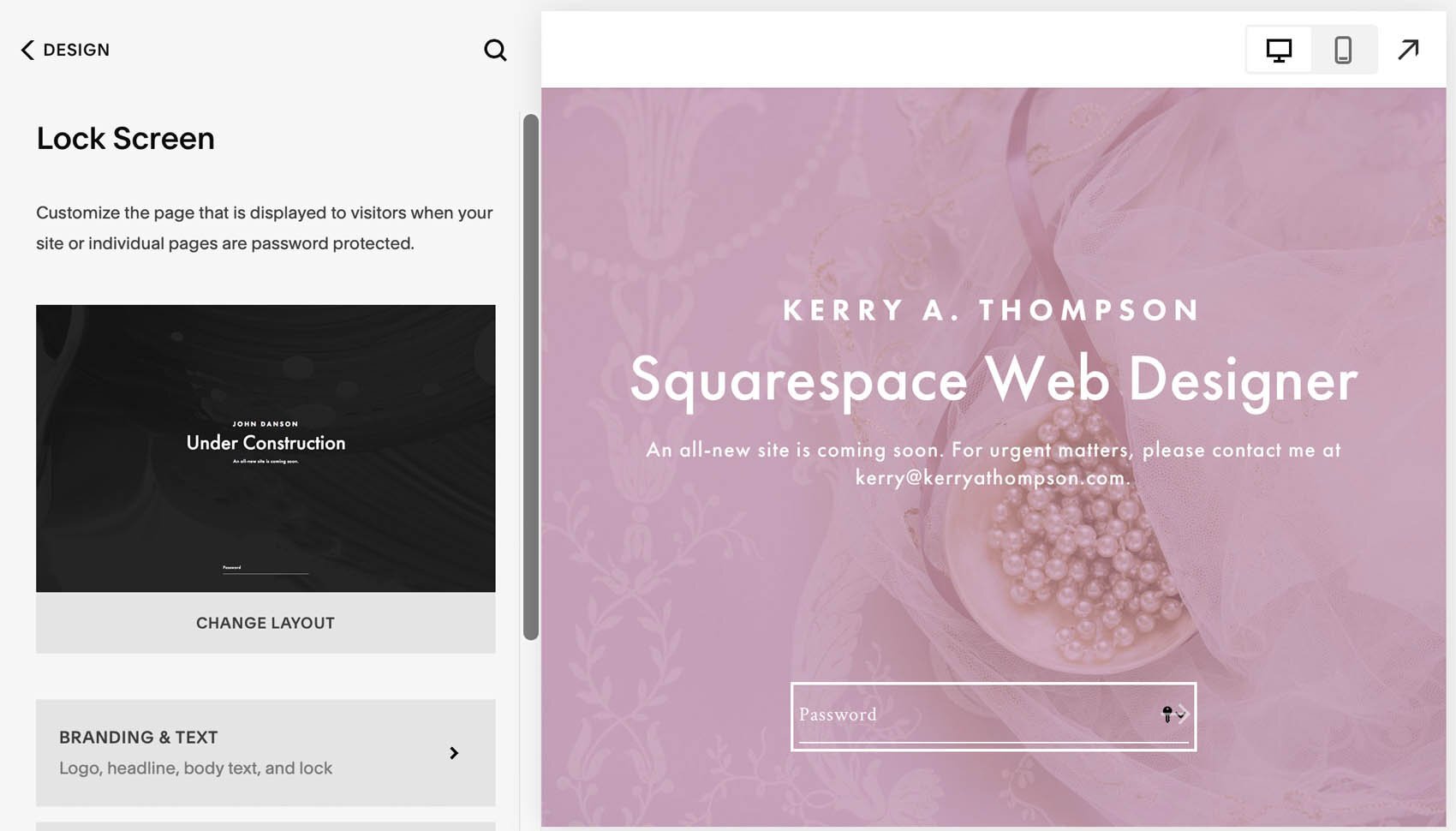
Squarespace offers a special home page called a lock screen that you can use while you're designing your website. The lock screen appears when people go to your website and it is password-protected.
Why I like lock screens
Lock screens offer more benefits than the standard "Under Construction" icon you see with not-quite-done websites.
You can start to build excitement about your new website. Depending on what you share on the page, curious visitors can get a sense of your company and its personality.
You give reviewers a way to look at the site without giving them editing access in Squarespace.
You don’t have to pay for a Squarespace hosting plan first to be able to create a site password and lock screen.
Set a site-wide password first
A Lock screen only works if you’ve password-protected the site first.
Go to Settings - Site Availability.
Select Password Protected.
Set the password.
Save your updated settings.
Anyone who visits the site while it is under construction must use this password.

Then design your lock screen
In the Squarespace editor, go to Design - Lock Screen. Choose a layout and add any text, pictures, or videos you'd like for this page. You can find more detailed instructions here.
Ideas for what to add to your lock screen
Consider the Squarespace lock screen a one-page preview for anyone who finds the site before it's ready. You'll want to entice visitors enough to want to come back when the website is ready. You could add your logo, the banner picture from your actual home page, and any headlines or introductory text visitors might want to know. You can even add videos or a slideshow to add even more visual interest and tell a story.
Unveiling your new website
When you are ready to make your website live, disable the site-wide password in Settings. The Lock Screen becomes inactive and the site's regular Home page now displays when people visit your site.
[Updated July 2023 with latest photos and instructions.]

Like the receptionist and reception area in an office, the Home page is the greeting area that needs to contain enough cues to reassure visitors that they're in the right place and give them guidance about how to find what they need and what to do now that they're there.

Squarespace assigns every new website a built-in domain, a Site ID, that ends with “squarespace.com.” I recommend changing the random ID Squarespace assigns to be something you’ll remember.
Understanding in advance how your website will support your business will inform your website's design and content.

The aspect ratio of an image is its width relative to its height. Understanding aspect ratio helps you design your pages with images that look attractive and well-matched. Aspect ratio choices can also help with planning and choosing images you’d like to use on your website.

Being able to preview your website live without logging out of Squarespace is a convenience for testing and proofreading before you launch.

To preview your Squarespace website as you’re designing it or to gather feedback from others before you launch, use these techniques to share your unpublished website.

To guide website visitors from being mildly interested in what you are offering to becoming clients and, ideally, your biggest supporters, your website needs clear paths to encourage them to take the next step.

If you have never had a website or have only created a website on your own without help, this blog post will explain the steps my clients and I take to go from our first talk to a finished website that helps their businesses shine online.

If you’re getting ready to create your first website, find out how you can claim that perfect domain name for your website.

Every website needs a Contact form so that visitors have an easy online way to get in touch with you. Learn about what a Contact form should contain and where it should be placed on your website.

Your website and your domain are connected, but can be separated too.

I always love it when I find something that speeds up repetitive tasks. So when I discovered the Squarespace shortcut of copying website pages to create backups, placeholders, and archived pages early in my website design career, I was sold.

Squarespace is my favorite website building platform. But when I was starting out, I took a look at Wix too. There was one quality that decide me against it.

When you buy an RV, it’s customary to take it for a shakedown cruise to reveal anything that’s not working as expected. A new website undergoes a similar shakedown process before I consider it done.

Squarespace offers a special home page called a lock screen that you can use while you're designing your website. The lock screen appears when people go to your password-protected website. Use a lock screen to build excitement for your brand, get a head start on Google search results, and provide a preview option for reviewers.

Whenever I start working with a client, I ask the client to make one or two decisions to narrow down the design choices. The first decision I ask clients to make is to choose a large image that goes the full width of the page or choose a narrower image with some "breathing room" on either side. If they prefer a wide edge-to-edge image, there's a second decision. Do they want the navigation text to appear above the image or within the image? Making that second decision narrows down design template choices to just a few.

On December 1, 2017, Squarespace changed which features are included in its lowest-cost Personal plan. Many simple customization and third-party integration features are now classified as Premium features, only available with the Business and Commerce plans. I'll have to take this into consideration as I talk with new clients about their options.
 Kerry A. Thompson
You don’t need a big agency to get your website done. You just need the one right person. I offer Squarespace website design and content development services for creatives, coaches, and healers. Learn more in a free 30-minute consultation.